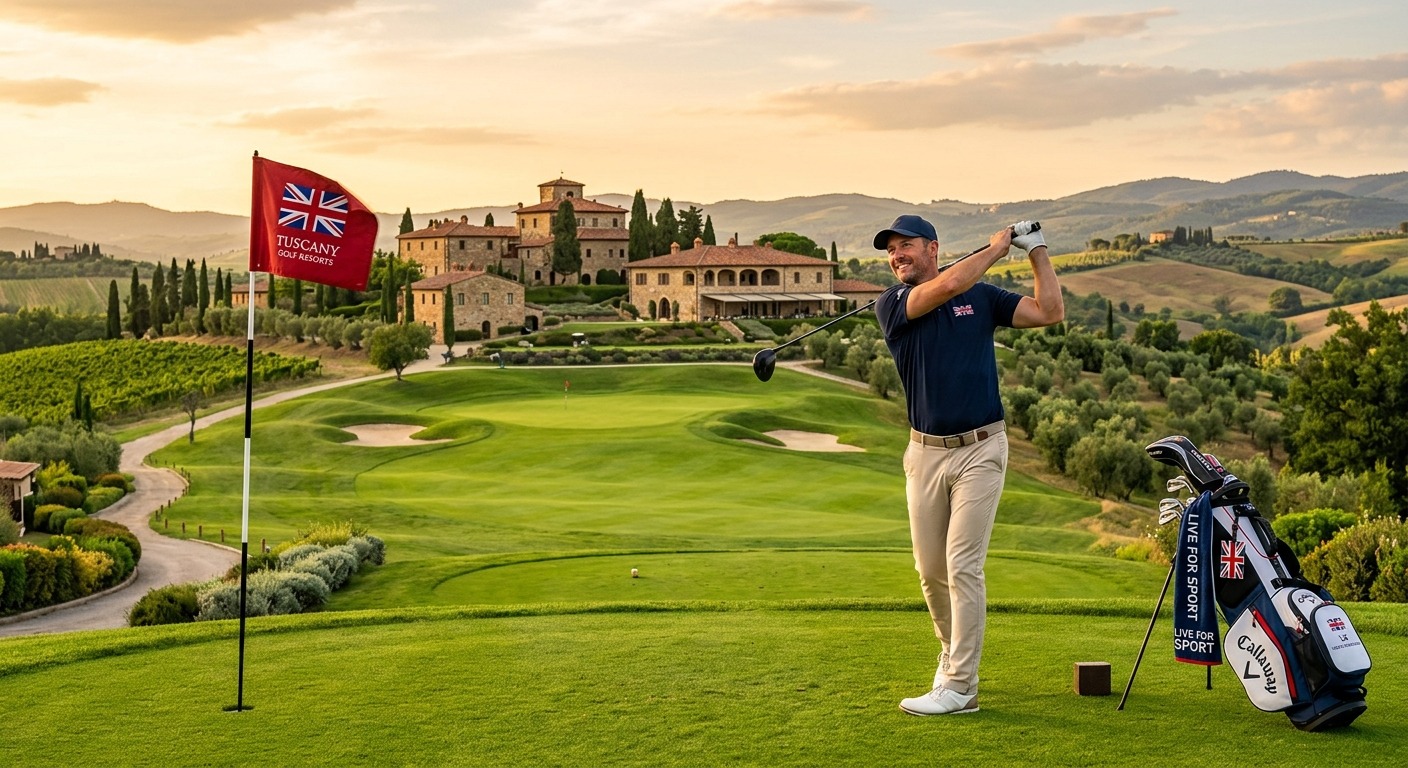
Tuscany Golf Resorts for British Travellers Who Live for Sport
There is a particular type of British holiday maker who arrives in Tuscany with a golf bag, a wine list already dog-eared at the Brunello section, and a phone that will quietly check race results before the second Aperol Spritz arrives. This person is not distracted. They are, in fact, living their best life. Tuscany has long attracted travellers for its culture, food, and countryside beauty. For golfers from the UK, it offers something richer still: courses that sit inside one of the world’s most visually extraordinary landscapes, paired with wine, spa rituals, and a pace of afternoon that nothing in Britain quite matches.
The Tuscan Golf Break: Three Things to Know
- Tuscany’s leading golf resorts deliver championship-standard courses alongside outstanding regional food, wine, and spa facilities that reward multi-day stays.
- Castelfalfi and Argentario Golf Resort represent two distinct styles of Tuscan golf, with inland hill terrain contrasting sharply against the coastal Maremma experience.
- British golfers rarely fully switch off from home sport, and Tuscany’s generous long lunches create the ideal setting for a quiet check-in before returning to the afternoon sun.
Why Tuscany Has Become a Serious Golf Destination for British Players
Tuscany was not always on the serious golfer’s radar. Italy as a whole was seen as a cultural destination first, a sporting one a distant second. That perception has shifted considerably over the past two decades. The region now hosts courses that would hold their own in any international context: layouts that use rolling hills, ancient olive groves, and sea views that other countries simply cannot replicate. The standard of resort infrastructure has risen to match.
For British travellers, the appeal is also practical. Tuscany sits within easy flying distance from most UK airports, typically around two hours. The climate between April and October is reliable in a way that British summers rarely manage. And the food and wine are not a bonus feature. For the golfer who lives for sport in all its forms, they are a destination in their own right.
Castelfalfi: A Course That Earns the Walk
Castelfalfi is one of those places that makes you feel slightly embarrassed about every other golf resort you have previously visited. The estate spreads across more than 2,700 hectares of Tuscan hills between Florence and Pisa. There are two courses here. The Mountain Course and the Lake Course cover very different terrain, and both reward a golfer who pays close attention.
The Mountain Course is the one that gets talked about. It climbs and drops through mature woodland, and the views from the upper holes take in a skyline of cypress trees and stone farmhouses that looks almost too composed to be real. The greens are fast in summer. The fairways are generous enough to encourage an ambitious tee shot without punishing every mishit. It does not play the same way twice, because the Tuscan light changes so dramatically through the day.
The village at the heart of the estate has been restored into a working community of restaurants, a spa, and accommodation ranging from hotel rooms to private villas. After eighteen holes, the ritual here is to sit on the terrace with a glass of Vernaccia di San Gimignano and do absolutely nothing constructive for at least an hour. Most British golfers manage about forty minutes before the scorecard comes out.
Argentario Golf Resort: Sea Air and a Course That Rewards Patience
Down on the Argentario peninsula in the Maremma, the resort takes on a completely different character. Argentario Golf Resort sits in the macchia mediterranea, the low-growing coastal scrubland that covers much of southern Tuscany. The course was designed by Robert Trent Jones Jr., and it plays nothing like anything you would find inland.
The wind off the Tyrrhenian Sea is a constant factor. Club selection becomes a puzzle in its own right. The course runs through cork oak and olive trees, and several holes offer water views that make it genuinely difficult to concentrate on the task at hand. The resort feels quieter and more exclusive than the larger Castelfalfi estate, which suits certain travellers very well indeed.
The food here leans heavily on the coastal larder. Fresh fish, local cured meats, and wines from the nearby Morellino di Scansano denomination fill the restaurant menus. After a round in the sea breeze, the combination of fresh pasta and a glass of something local becomes one of those simple pleasures that stays with you long after the round has been filed away.
Still Watching the Scoreboard: The British Golfer’s Quiet Connection to Home
There is a well-established ritual among British golfers on Tuscan terraces. The long lunch slows everything down. Conversation drifts between the morning’s round and broader sporting life back home. Someone at the table will eventually pull out their phone. Not to check emails. To see how the afternoon racing has gone.
It is not that the horses matter more than the Brunello. It is simply that a genuine sports enthusiast does not switch off entirely, even in paradise. The British sporting calendar runs all year, and a glance at UK horse racing results over a long Tuscan lunch is one of those small rituals that actually adds to the pleasure of being away. It is a moment of connection to home that makes the escape feel more complete rather than less.
This sits entirely within the Tuscan pace of life. The afternoon is not a time for rushing. It is for sitting, reflecting, and letting the morning’s sport settle. Whether the sport in question happened on a Castelfalfi fairway or a racecourse in Newmarket is, in that moment, simply part of the same generous day.
The Post-Round Hours: Spa, Wine, and the Tuscan Table
No honest account of Tuscan golf travel would be complete without proper attention to what happens after the clubs go back in the bag. The best resorts understand that a golfer’s afternoon matters as much as their morning, and they have invested accordingly.
The spa at Castelfalfi draws on thermal traditions the Tuscans have practised for centuries. Treatments using local ingredients, including olive oil, Chianti grape extracts, and mineral-rich muds from the nearby spa towns, appear on most resort menus. A post-round massage after four hours on hilly terrain is not an indulgence. It is a straightforward necessity.
Brunello di Montalcino is produced a short drive south of most of the major golf destinations, and it is one of Italy’s most celebrated red wines. A serious bottle of Brunello with dinner after a full day on the course is one of those combinations that simply works. The tannins, the length, the sense that you are drinking something that took years of patience to produce: it all mirrors what a good round of golf feels like when you have played it well.
Two Resorts, Two Experiences: Castelfalfi Compared to Argentario
| Feature | Castelfalfi | Argentario Golf Resort |
|---|---|---|
| Location | Tuscan hills between Florence and Pisa | Maremma coast, Argentario peninsula |
| Course Designer | Multiple designers across two layouts | Robert Trent Jones Jr. |
| Terrain and Character | Hilly, wooded, inland; dramatic elevation changes | Coastal scrubland; wind-affected; sea views throughout |
| Estate Scale | 2,700+ hectares; village, spa, multiple restaurants | Boutique and intimate; exclusive resort feel |
| Local Wine Culture | Near San Gimignano, Chianti Classico | Near Morellino di Scansano |
| Best Suited For | Groups, longer itineraries, inland Tuscany lovers | Couples, coastal seekers, those after seclusion |
The Landscape That Makes Every Round Feel Different
Tuscany is not simply a backdrop for the golf. It is one of the world’s most recognisable landscapes, and spending time within it changes how you experience the sport. The Val d’Orcia, a broad river valley south of Siena, carries its status as a World Heritage landscape for the quality of its Renaissance-era agricultural scenery. Several of Tuscany’s finest golf courses sit within easy driving distance of this area.
Playing a course where the view from the fifteenth tee includes a medieval hilltop town and a cypress-lined road that disappears into the heat haze is genuinely different from playing in Surrey. The landscape is not incidental. It is part of the game.
British travellers who take this seriously tend to build two or three days around the golf but leave space for a morning at a wine estate, an afternoon in Siena, and at least one very long dinner that runs past midnight. This is not wasted time. It is, in the Tuscan understanding of the good life, the whole point.
Choosing Your Season for the Best Tuscan Golf Experience
The Tuscan golf season runs effectively from March through to November. British golfers tend to cluster in specific windows for good reason:
- May and June: The countryside is green and full, temperatures are manageable on the course, and fairways are in excellent condition after spring preparation.
- September and October: The harvest season brings an extraordinary atmosphere to wine country. Courses are still warm and firm. The light in the late afternoon has a quality that golfers and photographers both find remarkable.
- July and August: The heat can be demanding for afternoon rounds. Early morning tee times are the answer, and the evenings more than compensate for any midday restrictions.
- April: Shoulder season pricing, fewer visitors on course, and a landscape still coming to life after winter. A genuine option for the golfer who values quiet fairways over guaranteed sunshine.
Building a Tuscan Golf Itinerary That Actually Delivers
A well-structured Tuscan golf trip needs some thought in advance. This is not a destination where you simply show up and improvise. Here is a practical framework for a week that covers sport, food, and everything in between:
- Arrive without rushing: Fly into Florence or Pisa, collect a hire car, and allow the first afternoon for orientation rather than cramming in a round. The drive through Chianti country to your base is part of the experience.
- Choose your anchor resort: Castelfalfi suits golfers who want inland scenery and easy access to Florence and Siena. Argentario suits those who want coast, warmth, and a more intimate scale.
- Plan for course variety: Book at least two different courses across the week. The contrast between an inland hill layout and a coastal design gives a fuller picture of what Tuscany offers as a golf destination.
- Build in a full rest day: A wine tour through Montalcino or a morning at the thermal baths in Saturnia will leave you sharper on the course rather than diluting the overall trip.
- Book early for peak season: The leading resorts fill up. Tee times and accommodation benefit from booking at least three to four months ahead, particularly for groups of four or more.
A Full Sporting Appetite, Satisfied on a Tuscan Fairway
The truest measure of a Tuscan golf break for the British sports enthusiast is whether it satisfies the full appetite. The morning tee time, the course itself, the post-round spa, the wine list at dinner, and even the quiet checking of a result from home: all of it belongs to the same experience.
Tuscany does not ask you to leave your sporting identity at the departure gate. It offers a landscape and a pace of life where the sport on the course and the sport back home sit comfortably alongside each other, separated by a few hours and a very good bottle of wine. That balance is, for a certain kind of British traveller, exactly what a proper holiday should feel like.
The courses here reward commitment. The food and wine reward patience. And the long Tuscan afternoons reward anyone who knows how to use them properly. For the British golfer who brings a full sporting appetite to everything they do, that is a combination worth flying for.