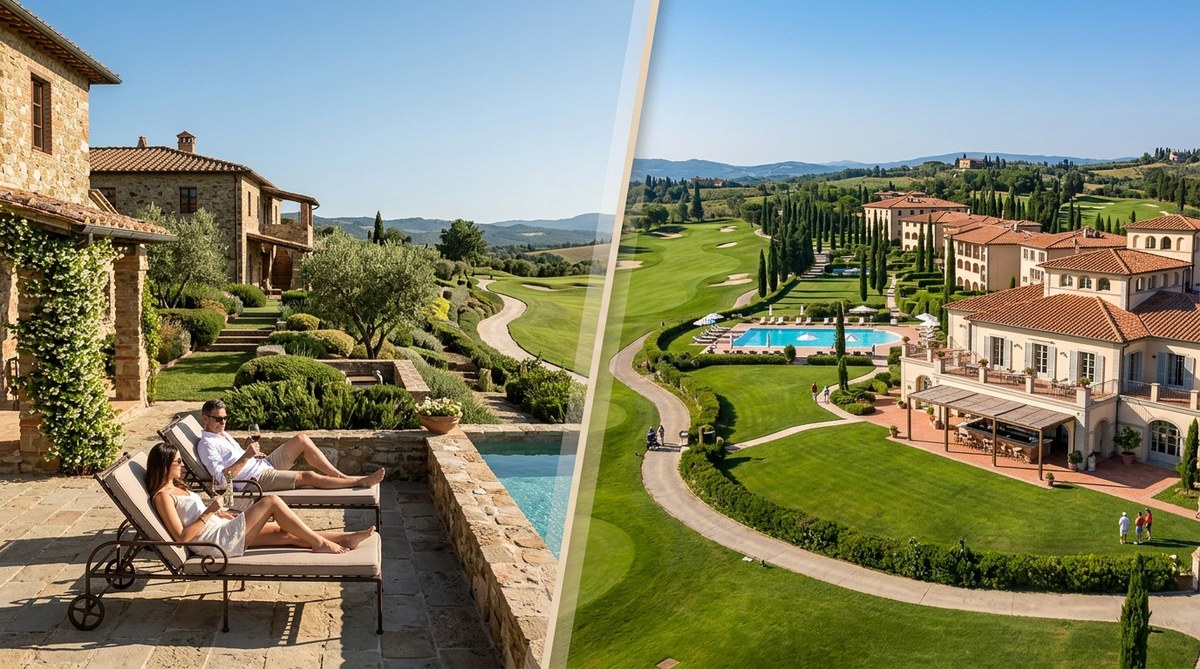
Boutique vs Grand Resort: Choosing Your Ideal Tuscan Golf Accommodation
Choosing where to stay can make or break your Tuscan golf holiday. The region offers everything from intimate 12-room villas to sprawling 200-acre resort complexes, each delivering a completely different experience. Your accommodation choice shapes not just where you sleep, but how you experience the courses, the cuisine, and the landscape itself.
Boutique properties offer personalised service, intimate atmospheres, and flexible tee times across multiple courses, whilst grand resorts provide on-site championship layouts, comprehensive amenities, and structured golf programmes. Your ideal choice depends on whether you prioritise variety and local character or convenience and full-service luxury. Most seasoned golfers book three nights at each type to experience both worlds during a week-long Tuscan golf holiday.
Understanding the boutique hotel advantage for golfers
Boutique properties in Tuscany typically house between 8 and 25 rooms. They sit in converted farmhouses, medieval towers, or historic villas.
The golf advantage here is flexibility. You’re not tied to a single course. Most boutique hotels partner with three to five nearby layouts, arranging tee times and transport as part of their concierge service.
Take a property in the Val d’Orcia. Your host books you at a different course each morning, all within 30 minutes’ drive. Monday you play a links-style coastal layout near Grosseto. Tuesday brings a parkland course threading through vineyards. Wednesday you tackle a mountain track with elevation changes that test club selection on every approach shot.
This variety matters when you’re spending a week in one location. Playing the same course five days running, no matter how excellent, grows repetitive. Boutique bases let you sample the region’s full golfing spectrum.
The dining experience differs too. Boutique properties often serve single-seating dinners where all guests eat together. You’ll share a table with other golfers, swapping course recommendations and arranging informal matches. These connections often lead to playing partnerships that last years.
Staff ratios run higher at boutique hotels. Expect one staff member for every two or three guests. Your host remembers you prefer an 8am tee time, that you need a practice session before competitive rounds, and that you’re hunting for a particular Brunello vintage.
“At boutique properties, the owner often lives on site and plays golf themselves. They know which courses suit high handicappers versus scratch players, which have the best practice facilities, and which restaurants near each club serve the finest post-round meals.” — Marco Bianchi, Tuscan Golf Concierge
What grand resorts deliver that boutiques cannot
Grand golf resorts in Tuscany occupy 200 to 500 acres. They feature on-site championship courses, often designed by notable architects.
The convenience factor is substantial. You walk from your room to the first tee in five minutes. No driving, no coordination, no weather-dependent transport plans.
These resorts offer structured golf programmes. Multi-day packages include guaranteed tee times, range balls, club storage, and post-round analysis sessions with resident pros. Some provide TrackMan data for every round, letting you compare performance across days.
The championship golf courses in Tuscany that challenge even seasoned players often anchor these large resorts, giving you immediate access to layouts that host professional tournaments.
Facilities extend beyond golf. Full spas, multiple restaurants, tennis courts, and swimming pools mean non-golfing partners find plenty to occupy their days. This matters when you’re travelling with a spouse who tolerates rather than shares your obsession with the game.
Grand resorts handle groups brilliantly. Booking eight rooms at a boutique property can be impossible. A 150-room resort absorbs your golf society without strain, offering dedicated dining areas and tournament coordination services.
The practice facilities at major resorts outclass anything boutiques can offer. Expect 300-yard ranges with target greens, short game areas with multiple bunker types, and putting greens that mirror the course conditions you’ll face during play.
How to choose based on your playing style and priorities
Your decision hinges on three factors: golf variety versus convenience, social atmosphere versus privacy, and flexibility versus structure.
Consider these scenarios:
Choose a boutique property if you:
- Want to play five different courses during a week-long stay
- Prefer personalised service over extensive amenities
- Enjoy meeting other guests and forming impromptu playing groups
- Value authentic Tuscan architecture over modern resort design
- Like flexibility in tee times and dining schedules
- Travel as a couple rather than a large group
Choose a grand resort if you:
- Want to master one excellent course during your stay
- Need on-site childcare or activities for non-golfing family
- Prefer structured programmes with guaranteed tee times
- Value having spa, gym, and dining options steps from your room
- Travel with a golf society or large group
- Want professional coaching and advanced practice technology
Your handicap matters less than you’d think. Both accommodation types serve players from beginners to single-digit handicappers. The difference lies in how you want to experience the region.
Some golfers split their stay. Three nights at a boutique property sampling different courses, then four nights at a grand resort focusing on one championship layout. This combination delivers variety early in the trip, then lets you settle into a rhythm and chase a personal best score.
Comparing costs and value across accommodation types
Price structures differ significantly between boutique properties and grand resorts. Understanding what’s included helps you compare true value.
| Feature | Boutique Properties | Grand Resorts |
|---|---|---|
| Room rate (per night) | €180-€400 | €250-€600 |
| Green fees included | Rarely | Often in packages |
| Breakfast | Usually included | Sometimes extra |
| Transport to courses | Arranged, often free | Not needed (on-site) |
| Range balls | Not applicable | Usually included |
| Spa access | Limited or none | Full facilities |
| Dinner options | One restaurant | Multiple venues |
| Cancellation terms | More flexible | Stricter policies |
Boutique properties typically charge lower room rates but require separate green fee payments. A week at a boutique hotel might cost €2,100 for accommodation plus €700 in green fees across five courses, totalling €2,800.
A grand resort package might cost €3,500 for the same week but include unlimited golf, range access, and club storage. The headline price looks higher, but the included elements often deliver better overall value for golfers playing daily.
Hidden costs appear at both property types. Boutique hotels may charge for wine with dinner, whilst resorts often price spa treatments and premium dining at eye-watering rates.
Transport costs favour resorts. Driving 30 minutes each way to different courses burns fuel and time. Calculate roughly €15 daily in fuel costs when staying at boutique properties, adding €105 to your weekly total.
The 5 Tuscan resorts that perfectly blend championship golf with spa luxury offer package deals that can reduce per-night costs significantly when booked three months ahead.
Regional variations in Tuscany golf hotels
Tuscany’s geography creates distinct accommodation clusters, each offering different golf experiences.
Chianti region (between Florence and Siena):
This area favours boutique properties. Rolling vineyard landscapes host converted farmhouses with 10 to 15 rooms. Golf courses here weave through wine estates, and Tuscan vineyard golf courses combine wine country charm with exceptional play in ways you won’t find elsewhere.
Accommodation tends toward rustic luxury. Exposed beams, terracotta floors, and antique furniture dominate. Expect smaller rooms but extraordinary character.
Maremma (southern coastal Tuscany):
Maremma is Tuscany’s hidden gem for golf and coastal luxury, hosting several grand resorts near the coast. These properties offer links-style courses with sea views and Mediterranean climates that extend the playing season.
Resorts here lean modern. Contemporary architecture, larger rooms, and beach club access define the experience. Prices run 20% lower than equivalent properties in Chianti or near Florence.
Val d’Orcia (southeast of Siena):
This UNESCO World Heritage landscape attracts boutique properties exclusively. The dramatic scenery and medieval hill towns create an unmatched backdrop, but golf courses sit further apart.
Staying here means prioritising landscape and culture over golfing convenience. Budget 45 minutes’ drive to most courses. The best golf courses near Florence for combining culture with your game require similar journey times from Val d’Orcia bases.
Florence surrounds:
A mix of both accommodation types appears within 30 minutes of the city. This location suits golfers wanting urban cultural experiences alongside their rounds.
Properties here book early. Florence’s popularity means golf hotels fill three to four months ahead during peak season (April to June, September to October).
Practical steps for booking your ideal Tuscan golf accommodation
Follow this sequence to secure the right property for your needs:
-
Define your golf priorities first, accommodation second. List the courses you want to play, then find accommodation that provides reasonable access to those layouts. Reversing this order often leads to disappointing course options.
-
Check tee time availability before booking rooms. Popular courses like Castello di Casole ranks among Europe’s most exclusive golf destinations and can be fully booked weeks ahead. Confirm you can actually play your target courses during your intended dates.
-
Contact properties directly for golf packages. Booking sites show standard room rates but miss golf-specific packages. A phone call or email to the hotel often reveals bundled offers that include green fees, cart hire, and practice range access at better rates than booking separately.
-
Request specific room locations at grand resorts. A 150-room resort might have accommodations spread across multiple buildings. Rooms nearest the clubhouse save 10 minutes of walking after early rounds. Request ground floor rooms if you’re travelling with heavy golf luggage.
-
Verify cancellation policies for both accommodation and tee times. Boutique properties typically offer flexible cancellation up to 14 days before arrival. Grand resorts often require 30 days’ notice and may charge cancellation fees for pre-booked tee times even if you cancel the room.
The planning your first golf holiday in Tuscany guide covers additional booking considerations, including travel insurance that covers golf equipment and weather-related cancellations.
What to expect from service standards at each property type
Service delivery differs fundamentally between boutique hotels and grand resorts, affecting your daily experience.
Boutique property service characteristics:
Staff wear multiple hats. Your breakfast server might also arrange your tee times and book dinner reservations. This creates continuity but can mean slower response times during busy periods.
Personalisation runs deep. After one night, staff know your coffee preference, your usual breakfast time, and whether you prefer morning or afternoon tee times.
Language skills vary. Smaller properties might have one English-fluent staff member who handles all guest communication. If that person has a day off, you might struggle with basic requests.
Flexibility peaks at boutiques. Want to change your tee time from 9am to 2pm? Need a packed lunch instead of the set dinner? Prefer to eat at 7pm instead of the communal 8pm seating? Boutique properties accommodate these requests easily.
Grand resort service characteristics:
Specialisation defines the experience. Separate staff handle golf operations, dining, spa bookings, and concierge services. Each team knows their domain thoroughly but may not coordinate well across departments.
Consistency matters more than personalisation. You’ll receive excellent service, but staff may not remember your preferences from day to day. Larger teams mean higher turnover and less continuity.
English proficiency is universal. Major resorts hire multilingual staff and provide service in English, German, French, and Italian without difficulty.
Structured systems replace flexibility. Tee times follow set intervals. Restaurants operate fixed hours. Spa treatments require advance booking. The trade-off is reliability but less spontaneity.
Common mistakes when choosing Tuscany golf hotels
Golfers repeatedly make these errors when booking accommodation:
Mistake 1: Prioritising room luxury over golf access. That stunning infinity pool looks magnificent in photos, but if it’s 50 minutes from decent courses, you’ll spend more time driving than playing. Choose accommodation within 30 minutes of multiple quality layouts.
Mistake 2: Booking boutique properties for large groups. Eight golfers overwhelm a 12-room boutique hotel. You’ll dominate the dining room and limit other guests’ experiences. Groups of six or more belong at grand resorts.
Mistake 3: Assuming on-site courses offer better value. Some resort courses charge premium rates because they can. Playing the resort course five times might cost more than sampling five different layouts from a boutique base, and variety often delivers better value.
Mistake 4: Ignoring seasonal weather patterns. Tuscany gets hot. July and August temperatures regularly exceed 35°C, making afternoon golf miserable. Book accommodations with early morning tee time access during summer months. Spring and autumn offer better playing conditions.
Mistake 5: Overlooking non-golf amenities for partners. If you’re travelling with a non-golfing spouse, a boutique property in an isolated vineyard setting might leave them bored. Grand resorts provide activities that keep everyone happy.
The how to plan a golf holiday in Tuscany timeline helps you avoid these pitfalls by structuring your booking process logically.
Amenities that matter most for serious golfers
Certain facilities significantly impact your playing experience and practice routine:
Club storage and cleaning: Grand resorts typically offer secure club storage with overnight cleaning. You hand over your bag after your round and collect it cleaned and ready the next morning. Boutique properties rarely provide this service. You’ll store clubs in your room and clean them yourself.
Practice facilities access: If you’re serious about your game, unrestricted range access matters. Grand resorts usually include range balls in room rates or golf packages. Boutique properties require you to pay range fees at each course you visit, adding €10-€15 per session.
Golf cart availability: Tuscany’s hilly terrain makes walking challenging on many courses. Grand resorts include carts in most packages. When playing from boutique bases, confirm cart availability at each course and book them when reserving tee times. Some traditional Italian courses discourage carts outside medical necessity.
Laundry services: Playing daily means washing golf clothing frequently. Grand resorts offer same-day laundry, returning clothes cleaned and pressed by evening. Boutique properties might offer laundry every two to three days, requiring you to pack more golf outfits.
Early breakfast options: Serious golfers want 7am tee times to avoid afternoon heat. This requires breakfast at 6am or earlier. Grand resorts accommodate this easily. Boutique properties may struggle with breakfast before 7:30am unless you arrange it the previous evening.
The art of the 19th hole in Tuscany extends beyond the course itself, and your accommodation choice influences how you experience post-round relaxation.
Combining accommodation types for the ultimate golf holiday
The smartest golfers don’t choose between boutique and resort. They book both.
A typical seven-night itinerary might look like this:
Nights 1-3: Boutique property in Chianti
Arrive refreshed and ready to sample variety. Play three different courses over three days. Experience intimate Tuscan hospitality. Enjoy wine-focused dinners with other guests. Build a sense of the region’s golfing landscape.
Nights 4-7: Grand resort in Maremma
Settle into one excellent course. Focus on improving your score through repetition. Access professional coaching. Let your partner enjoy spa treatments whilst you practice. End the holiday feeling accomplished rather than rushed.
This split approach costs roughly the same as seven nights at either property type alone. You simply redistribute your budget across both experiences.
The transition day between properties becomes a rest day. Pack in the morning, drive two hours south, check in after lunch, and skip golf entirely. Your body needs recovery after three consecutive playing days.
Booking two properties requires more coordination but delivers superior experiences. You get variety, intimate service, convenience, and comprehensive facilities all in one holiday.
The where to stay for the ultimate Tuscan golf holiday breaks down specific property recommendations for this split-stay approach.
Making your accommodation decision with confidence
Your ideal Tuscany golf hotel depends on what you value most in a golf holiday.
If you’re the type of golfer who loves discovering new courses, meeting fellow players over dinner, and experiencing authentic local character, boutique properties deliver exactly that. You’ll sacrifice some convenience and comprehensive amenities, but you’ll gain flexibility, personalisation, and variety.
If you prefer mastering one excellent course, having everything you need within walking distance, and knowing exactly what to expect from your accommodation, grand resorts serve you better. You’ll pay more and experience less local character, but you’ll enjoy superior facilities and structured golf programmes.
Most golfers find their sweet spot by trying both. Book a boutique property for your first Tuscan golf trip. If you love the variety but miss the convenience, choose a grand resort next time. If you loved everything about the boutique experience, find another excellent small property in a different Tuscan region.
The 7 most scenic golf courses in Tuscany span the entire region, and your accommodation choice determines which ones you can reasonably access during your stay.
There’s no wrong choice here. Both accommodation types deliver exceptional golf holidays. The only mistake is booking without understanding what each offers and what matters most to you.
Start by listing your top three priorities for this trip. Then match those priorities to the accommodation type that delivers them best. Your perfect Tuscan golf hotel is the one that aligns with how you want to spend your time, not the one that looks best in photographs or costs the most per night.
The where to find Tuscany’s best wine pairings after your round matters just as much as where you sleep, and both boutique properties and grand resorts offer access to exceptional wine experiences that complement your golf perfectly.
Finding your perfect match in Tuscany’s golf accommodation landscape
The boutique versus grand resort decision ultimately reflects your golfing personality and holiday priorities.
Some golfers thrive on variety and spontaneity. Others prefer routine and comprehensive facilities. Neither approach is superior. They simply serve different needs and deliver different experiences.
Your best strategy is to be honest about what you actually enjoy rather than what you think you should prefer. If you love the idea of a small villa but know you’ll miss having a spa and multiple restaurants, choose the resort. If you’re drawn to grand properties but suspect you’ll feel anonymous in a 150-room complex, book the boutique hotel.
Tuscany offers world-class golf accommodation in both categories. Your job is simply to match your preferences to the right property type, then book with confidence knowing you’ve chosen wisely for your specific needs and playing style.